

Contents
- 1 How to organize a 2026 World Cup predictor pool?
- 2 From the Round of 32 onwards, what happens if the Round of 32 match is not correctly predicted, but the result of a team is?
- 3 From Round of 32 onwards, What result counts if a match ends in a draw?
- 4 At the end of the prediction pool, what happens if there is a tie for first place?
- 5 How to organize a prediction pool in stages (first the group stage, and then the knockout stage)
- 6 What is the best scoring system?
How to organize a 2026 World Cup predictor pool?
- Go to https://matejero.com/world-cup-excel-sweepstake/
- There are 2 files to download: 1 for the participant and 1 for the administrator.
- Open the administrator file, and in the “ADMIN” sheet, assign points to each criterion in the scoring table.
- Send the participant file to those who are going to participate in your pool, along with the scores and instructions so they know them in advance.
- When the participants send you their completed file, copy their predictions from the “Pool” sheet into the “ADMIN” sheet of the administrator file.
- Once they have sent you all their predictions, select the exact number of players in the selector on the “ADMIN” sheet.
- When the 2026 World Cup starts, fill in the results as they occur in the “WorldCup” sheet of the Administrator file.
- The classification will be updated automatically as you enter the results in the “World Cup” sheet that take place in the 2026 World Cup.
From the Round of 32 onwards, what happens if the Round of 32 match is not correctly predicted, but the result of a team is?
(This applies to the Round of 32 as well as the Round of 16, quarter-finals, semi-finals, 3rd and 4th place, and the final).
As explained in the 2026 World Cup Excel scoring system
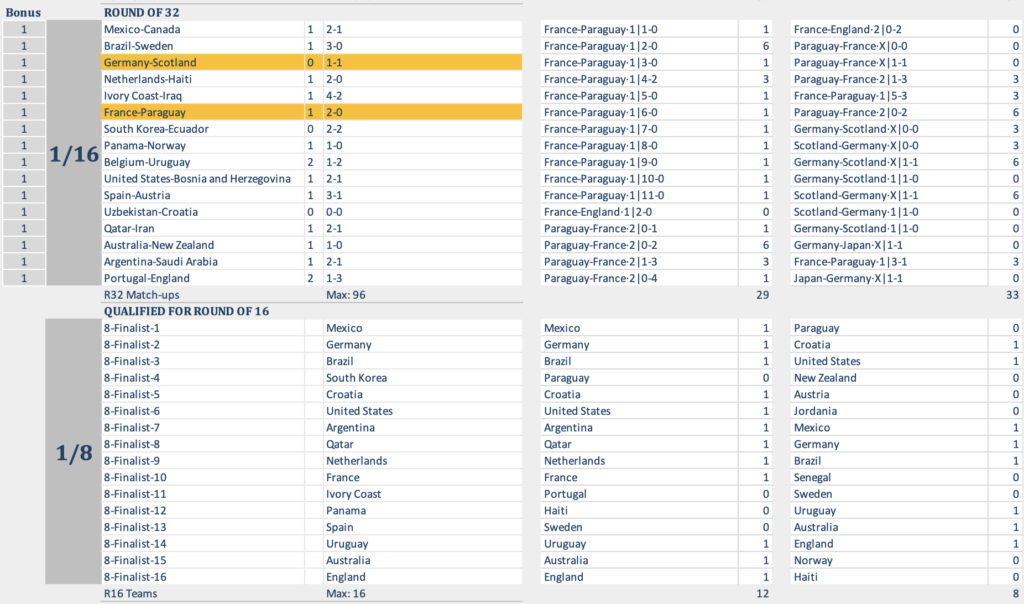
- As a general rule, if a match doesn’t exist, it doesn’t score points. In the example below, the match Croatia 0 – France 1 predicted by a participant doesn’t exist. Even if France won their Round of 32 match 0-1, it doesn’t score points because that specific match doesn’t exist. However, the participant can still score with the “Team qualified for the ROUND OF 16” criterion, provided they correctly predicted the qualifying team.
- If a match exists but doesn’t match the row, it can score points if the result and/or the sign are correct. It can also score with the “Team qualified for the ROUND OF 16” criterion, provided they correctly predicted the qualifying team.
- If a match exists but the home and away order is swapped, it can also score points if the result and/or the sign are correct. The row in which it is located doesn’t matter. In this case, it can also score with the “Team qualified for the ROUND OF 16” criterion, provided they correctly predicted the qualifying team.
Let’s imagine that we give the following points in the ROUND OF 32:
| ROUND OF 32- 1X2 (home, draw, away) | 1 |
| ROUND OF 32 – Goal difference/distance (With correct 1X2)** | 2 |
| ROUND OF 32 – Exact Result | 3 |
| Nation Qualified for ROUND OF 16 | 1 |
| % Adjustment for desviation in Goal difference/distance: -> | No adjustment |
Let’s look at the dummy match France 2 – Paraguay 0 and how points would be added with the following dummy results from participants. Obviously, the scenarios on the right won’t actually happen like that, but they serve to illustrate with an example the points scored with different possibilities.
From Round of 32 onwards, What result counts if a match ends in a draw?
(This applies to the Round of 32 as well as the Round of 16, quarter-finals, semi-finals, 3rd and 4th place, and the final).
- If there is no draw, the result that counts is the one at the 90th minute.
- If there is a draw at the 90th minute, the result that counts is the one at the 120th minute.
For example, in the fictitious Round of 16 match Mexico vs. Canada:
- If the score is 0-0 at the 90th minute and 1-0 in favor of Mexico at the 120th minute, the result that counts is the 1-0 at the 120th minute.
- If the score is 2-2 at the 90th minute and remains 2-2 at the 120th minute, the 2-2 would still count, as there is no change.
- If the score is 2-2 at the 90th minute and 3-3 at the 120th minute, the result that counts is the 3-3 at the 120th minute.
- If the score is 1-0 at the 90th minute, the result that counts is the 1-0. There would be no extra time in this case.
| Minute 90′ Result | Minute 120′ Result | What result counts? |
|---|---|---|
| Mexico 0 – 0 Canada | Mexico 1 – 0 Canada | 120′: Mexico 1 – 0 Canada |
| Mexico 2 – 2 Canada | Mexico 2 – 2 Canada | 120′: Mexico 2 – 2 Canada |
| Mexico 2 – 2 Canada | Mexico 3 – 3 Canada | 120′: Mexico 3 – 3 Canada |
| Mexico 1 – 0 Canada | – | 90′: Mexico 1 – 0 Canada |
At the end of the prediction pool, what happens if there is a tie for first place?
At the end of the prediction pool, there may be two or more participants tied for first place. In this case, the winner is determined by the organizer’s criteria. Here are some possible options:
- If there is a prize for the winner, it can be divided among the participants tied for first place.
- The participant who submitted their predictions first wins.
- The participant who guessed the most exact results in the group stage wins.
- A draw is held to determine the winner.
How to organize a prediction pool in stages (first the group stage, and then the knockout stage)
- Participants predict the results of the group stage.
- As the administrator, you copy and paste each participant’s predictions into the administrator sheet, according to the “Pool” sheet in each participant’s file.
- While the group stage is taking place, you must fill in the results of the group stage separately in a participant file. Once the group stage has concluded, send that file to the participants so they can complete their predictions for the knockout stages. (Since the real-life results will have determined the Round of 32 matchups). BE CAREFUL!, there is only a half-day window to complete the results, as the last match of the group stage is on June 27th and the first Round of 32 match is on June 28th, right on the following day.
- You copy the results of the knockout stages of each participant according to the “Pool” sheet and paste it as values in the administrator sheet, in the column corresponding to each participant.
What is the best scoring system?
There isn’t one single best scoring system. It depends on the type of pool (by stages or for the full tournament) and what a group values most. Some groups value hitting the match results more than predicting who advances, while others prioritize picking the teams that move on over the exact scores.
To give you an idea of how many points are awarded per round, below the scoring criteria table, we’ve added a summary table showing the maximum points that can be earned in the group stage and the maximum points possible in the knockout stages.
In my Office, we run our pool for the full tournament, before the World Cup begins.
We like to keep participants engaged for as long as possible, as that maintains the excitement and healthy rivalry among everyone. In our group, we try to award increasing points for predicting who advances, so those who didn’t get many results right during the group stage still have a chance to finish in the top positions.
We asked Gemini for a fair scoring system, and it responded with the following:
There isn’t a single scoring system that’s the best for every pool. The choice of the system will depend on several factors, such as:
- The scoring criteria that are considered most important:
- Correct results: If the goal is to reward the ability to predict the exact score of the matches, more points should be given to this criterion.
- Team qualification: If the goal is to reward the ability to predict which teams will advance to the next stages of the tournament, more points should be given to this criterion.
- Prediction difficulty: Higher points can be assigned to more difficult predictions, such as guessing the exact score of a match with many goals.
- The type of prediction pool:
- Private pool: In a private pool among friends, you can choose a more complex scoring system tailored to the group’s preferences.
- Public pool: In a public pool with many participants, a simpler and easier-to-understand scoring system is usually chosen.
- Recommendations:
- Ask participants: It’s important to consult with the pool participants to know their preferences and choose a scoring system that everyone likes.
- Communicate the scoring system in advance: The scoring system should be communicated to all participants before the 2026 World Cup begins so they can make their predictions with full knowledge of the rules.
